

Humanities-AI Network

Seminar series
January 2026
IS AI OUR NEW GOD?
We often view AI as cold science, yet Silicon Valley speaks of 'salvation' and 'apocalypse'. In this opening session, we ask if we are re-enchanting a secular world with magic algorithms, effectively building a new deity to solve our problems.

March 2026
THE GHOST IN THE MACHINE
If an algorithm writes a heartbreaking poem without feeling heartbreak, does the poem mean anything? We challenge the idea that technical proficiency equals creativity, debating whether literature is a transmission of the soul or merely words in a pretty order.

May 2026
HISTORY BY CONFIRMATION BIAS
Historians warn that LLMs may simply tell us what we want to hear. We discuss the danger of 'history by confirmation bias', asking if AI can ever produce original insight or if it is doomed to reinforce existing narratives and generic summaries.

July 2026
THE END OF THE MASTERPIECE
Walter Benjamin warned that cheap copies destroy the 'aura' of original art. In an age where Midjourney generates infinite content, we debate whether we are democratising art for everyone or turning human expression into disposable data.

September 2026
CAN A COMPUTER HAVE A BODY?
Hubert Dreyfus argued that intelligence requires 'being-in-the-world'. We explore the theory that we think with our bodies and our situation — things a server farm cannot possess. Can a disembodied AI ever truly 'think'?

February 2026
ROBOTS WITH RIGHTS?
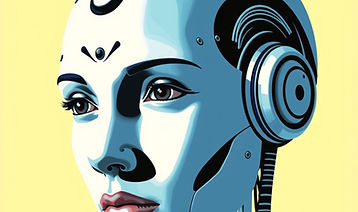
Challenging the concept of 'biologism', we explore the dilemma of sentience. If a machine becomes smart enough to have interests or claim fear, are we accidentally creating a race of slaves? We discuss the 'New Speciesism' and the difficulty of proving consciousness.
April 2026
MONSTERS AND MAKERS
Using Mary Shelley’s Frankenstein as our guide, we examine why humanity is obsessed with creating things that look like us, only to reject them when they become too real. Are we afraid of the monster, or of recognising ourselves in the mirror it holds up?

June 2026
THE ALIGNMENT PROBLEM
LLMs operate on probability; humans operate on lived experience. We tackle the fundamental mismatch between data scraping and social interaction, discussing the risk of 'epistemicide' — where models trained on dominant cultures flatten diverse ways of thinking.

August 2026
THE DEEPFAKE DILEMMA
From voice cloning to copyright wars, we explore the 'digital replication right'. We examine the ethical nightmare of posthumous voice replication, asking: "Is this a technological breakthrough or a form of 'digital grave-robbing'?"

October 2026
THE FUTURE OF HUMANITIES
In our final session, we move from critique to 'paradoxical optimism'. We discuss how the automation of the formulaic might free the humanities to become 'maximalist' — focusing on the extraordinary, poetic and singular aspects of thought that machines cannot replicate.
